Mechanical Behavior

Correlating alloy composition with hydrogen embrittlement behaviors in austenitic alloys

The objective of this project is to enable deliberate development of cost-effective, hydrogen resistant alloys by establishing detailed relationships specific to the effects of alloy compositionshort range ordering (SRO), and microsegregation in the presence of hydrogen on the transition between homogeneous deformation and localized plasticity in shear bands. In collaboration with the International Institute for Carbon-Neutral Energy Research, I2CNER, at Kyushu University in Japan, we conceptualized, designed, and manufactured four austenitic alloys that maintain corrosion resistance and ensure lower cost relative to baseline commercial alloys. The mechanical properties and deformation modes of the novel alloys (KU alloys) were assessed in the presence of hydrogen (H).  Correlations between composition and performance revealed that two of the KU alloys are suitable replacements for 316 steel, while another is a viable replacement for 304 steel at room temperature. We found that, in the presence of other austenite stabilizing elements namely Mn and N, replacing Ni with Cu does not lead to martensite formation as has been previously reported. Furthermore, we found that the addition of Cu leads to an earlier onset of multiple slip resulting in an relative earlier onset of a higher work hardening rate (WHR).

Greater understanding of the relationships between alloy composition and SRO required the development of a novel advanced electron diffraction methodology to characterize SRO in complex FCC alloys. This innovative approach, which combines fluctuation and correlation analyses of diffuse-scattering signals, successfully differentiated between SRO and long-range ordering (LRO). Further investigations into annealed austenitic stainless steels could provide insights into manipulating SRO and its effects on material properties. Atomistic simulations provided understanding of SRO behavior that was difficult to capture experimentally. This project created the first spin cluster expansion model that is able to capture and describe SRO effects in Fe-Ni-Cr FCC alloys, accounting for the non-negligible effects of magnetism. An automated computational workflow was established to provide reliable predictions of SRO in Fe-Ni-Cr austenitic alloys, both with and without the presence of H atoms. Analysis of the propensity for SRO in Fe-Ni-Cr alloys revealed that H tends to cluster with specific, well-defined SRO domains. The computational framework is general purpose and can be extended to realistic stainless steels across diverse composition ranges. With confidence that SRO is possible in austenitic stainless steels, we developed a discrete dislocation finite element code to understand the interaction of dislocations with SRO in the presence of H. By incorporating H effects on the dislocation emission and SRO stress field we show that the critical stress for the dislocation pileup to breakthrough the SRO domain decreases in the presence of H, which directly contributes localized deformation at the macroscale. Through the simulation of a uniaxial tension test, we demonstrated that H-induced weakening of SRO stress field and H-enhanced dislocation emission can lead to the onset of shear localization at lower macroscopic strains.


As a whole, this project identified three novel alloys that show improvements in performance and cost efficiency for H-facing applications by studying correlations between alloy chemistry and deformation behavior. We also made significant advancements to experimental and computational methodologies necessary to study the chemistry and distribution of SRO across a range of alloys, which in turn allowed us to demonstrate how deformation mechanisms change due to the contributions of SRO in austenitic alloys in the presence of H. The combined advancements in fundamental understanding with novel alloy development in this project has increased the viability of next generation H-technologies for the broader public through accessible low-cost alloys and accelerated development towards future H-infrastructure.

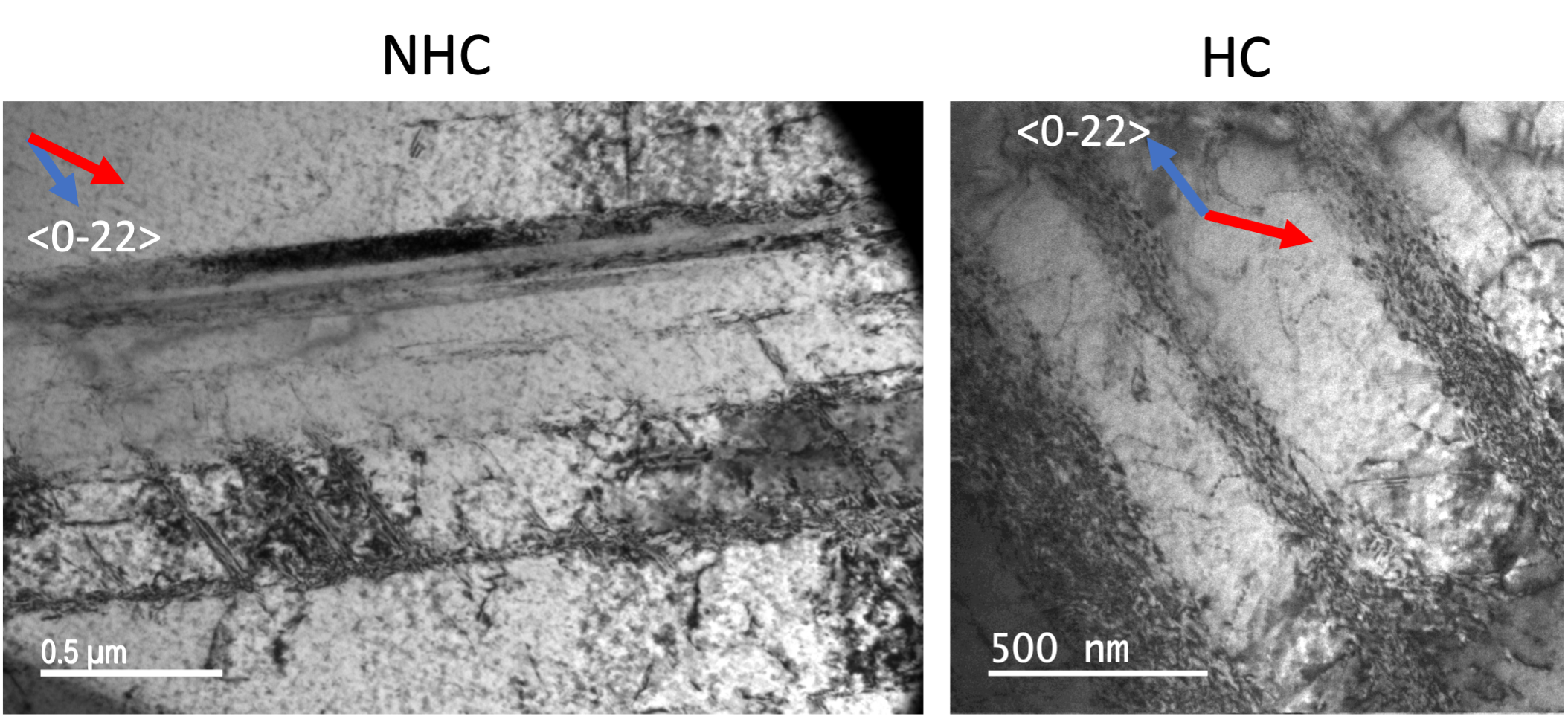
Comparison of the dislocation microstructure in a deformed, custom austenitic steel in the uncharged (NHC) and hydrogen charged (HC) conditions.

To learn more, check out some of our publications from this project:

  • P-C. Kung, T. Su, E. Ertekin, J-M. Zuo, J.A. Krogstad. “Universal Electron Diffuse Scattering in FCC Alloys: A Kinematic Thermal Diffuse-Scattering Analysis.” Under review at Physical Review Materials (2026)
  • Tianyu Su, Brian J. Blankenau, Namhoon Kim, Petros Sofronis, Jessica A. Krogstad, Elif Ertekin. “Short-range order influences H distribution in Fe-Ni-Cr austenitic stainless steels.” (2026) Under Review at Materials & Design.arXiv:2511.07804
  • K. Vijayvargia, Z. S. Hosseini, M. Dadfarnia, B. P. Somerday,  J. A. Krogstad, M. Kubota, T. Tsuchiyama, N. Aravas, P. Sofronis. “On hydrogen-induced shear localization in austenitic steels triggered by dislocation interactions with short-range order.” International Journal of Solids and Structures. 324 (2026): 113662DOI: 10.1016/j.ijsolstr.2025.113662
  • Z. S. Hosseini, K. Vijayvargia, M. Dadfarnia, B. P. Somerday, J. A. Krogstad, M. Kubota, T. Tsuchiyama, P. Sofronis. “Micromechanical modeling of hydrogen, dislocation, and short-range ordering interactions for austenitic steels.” Modelling Simul. Mater. Sci. Eng. 33 085004(2025). DOI:10.1088/1361-651X/ae16c6 
  • Tianyu Su, Brian J. Blankenau, Namhoon Kim, Jessica A. Krogstad, Elif Ertekin. “Nitrogen-related short-range order in Fe-Ni-Cr austenitic stainless steels: first principles and cluster expansion study.” Computational Materials Science 260 (2026): 114218. DOI: 10.1016/j.commatsci.2025.114218
  • P-C. Kung, R. Feng, P. Liaw, J-M. Zuo, J.A. Krogstad. “Differentiating Electron Diffuse Scattering via 4D-STEM Spatial Fluctuation and Correlation Analysis in Complex FCC Alloys.” Ultramicroscopy (2025): 114228. DOI: 10.1016/j.ultramic.2025.114228
  • T. Su, B.J. Blankenau, N. Kim, J.A. Krogstad, E. Ertekin. “First-principles and cluster expansion study of the effect of magnetism on short-range order in Fe-Ni-Cr austenitic stainless steels.” Acta Mater 276 (2024): 120088. DOI: 10.1016/j.actamat.2024.120088
  • Sofronis, Petros, Krogstad, Jessica, Ertekin, Elif, et al., “Tailoring composition and deformation modes at the microstructural level for next generation low-cost high-strength austenitic stainless steels,” (2025), https://doi.org/10.2172/2588951

Deformation mechanisms in high performance ceramics
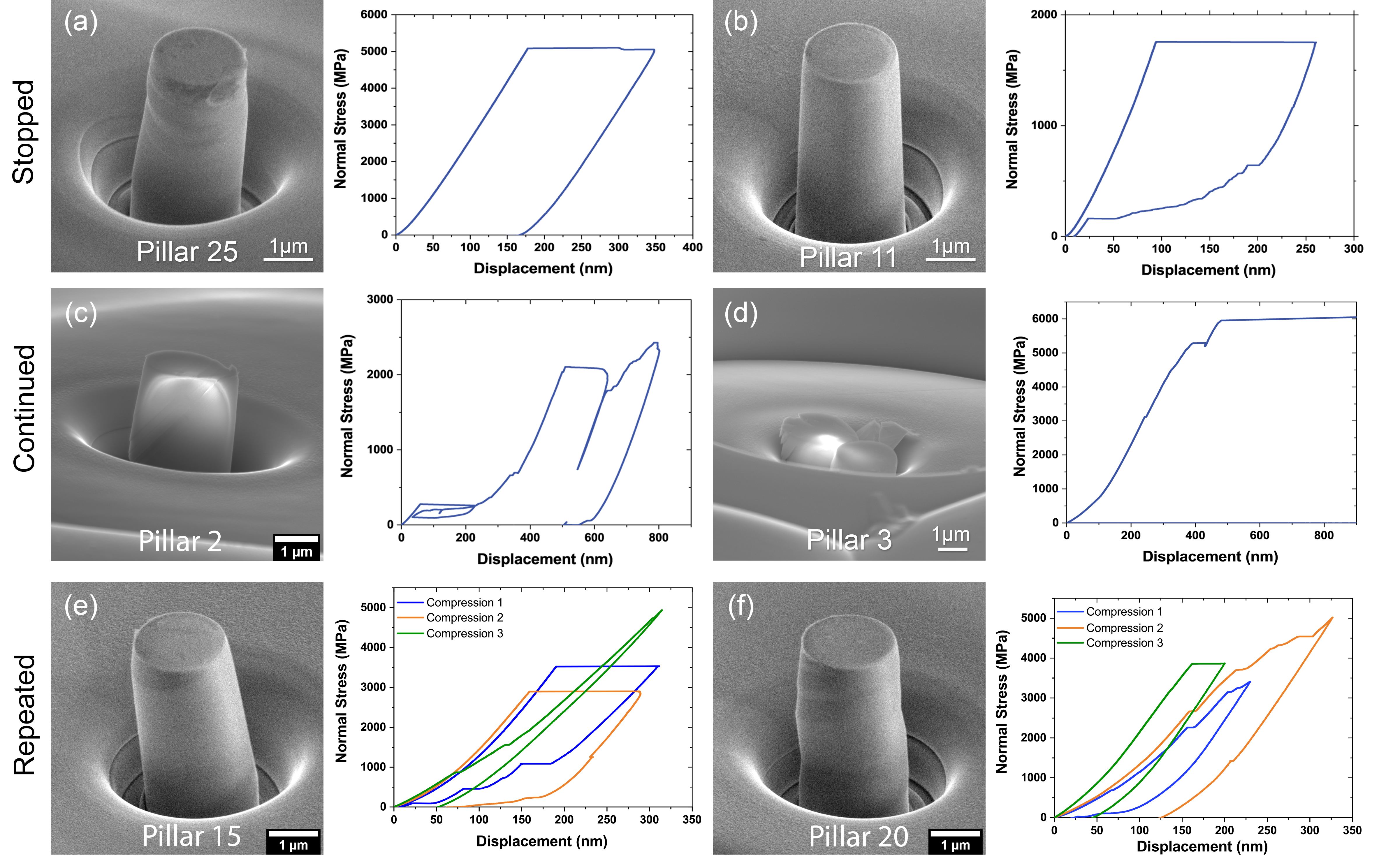
Comparison of microcrystal deformation behavior in ceria-titania stabilized tetragonal zirconia grains of different orientations.

In situ deformation and advanced application of orientation mapping are at the center of our efforts to understand the mechanical behavior of ferroelastic, polycrystalline ceramics.